Tamal-making: Connection to Children’s Literature
Tamal-making and tamaladas bring families together and connect families through tradition and history. Themes of family, tradition, and belonging have come up time and time again during our studies of Latina/o/x cultures. A perfect example of how the influence of tamal-making connects to themes of family and belonging is evident in children’s literature.
For example, historically, young girls progressed in their roles in tamal-making as they got older and more responsible. This is emulated in Gwendolyn Zepeda’s children’s book, Growing up with Tamales, where Ana, a six-year girl cannot wait to grow up because as she gets to be older, she becomes more responsible in the tamal-making process (Knepp 197).
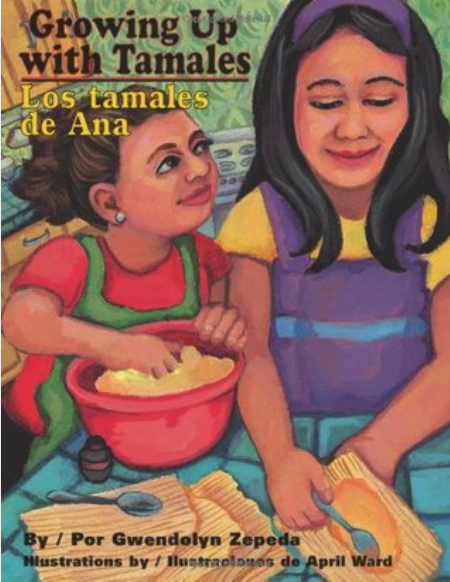
Ana, seen on the left hand side of the photo, looks up at her older sister, whose role as an eight year old is to spread the masa dough on the corn husks, while Ana’s role as a six year old is to mix the masa dough. As Ana imagines herself growing up, she gets excited about the day when she turns 18 and can do all of the steps in the tamal-making process and then deliver the tamales to her family on Christmas in a delivery truck called “Ana’s Tamales” (Knepp 198). This sense of pride showcases the importance of tamales and by extension, her family’s traditions and culture. Additionally, since this is a children’s book, “young Latina readers can feel this same sense of cultural empowerment as they share Ana’s excitement for tamales” (Knepp 198).
Another children’s book that highlights the theme of family in relation to tamales is Gary Soto’s Too Many Tamales.
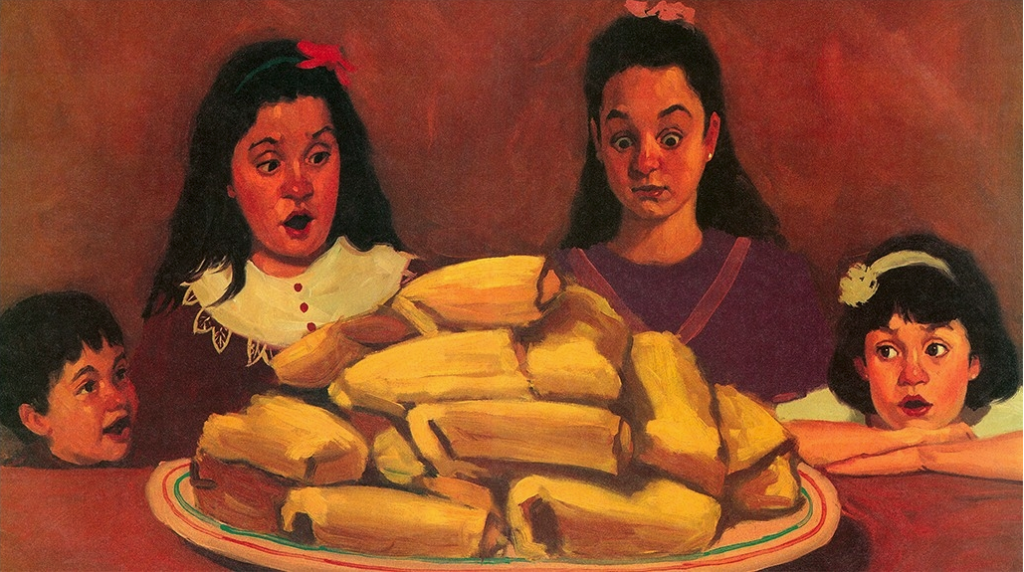
In Too Many Tamales, Maria and her mother are preparing tamales for their Christmas party with family, when Maria tries on her mother’s wedding ring while her mother is distracted. Maria goes back to kneading the masa dough and later, when her family arrives, she realizes that the ring is no longer on her finger and assumes it might have fallen into one of the tamales. So, Maria gathers her cousins (seen in the above photo) to eat the tamales until the ring is found. However, the cousins eat all of the tamales with no ring in sight. Maria decides she must confess to her mother that she lost her wedding ring when to her surprise, her mother says she found the ring earlier in the masa dough. However, now that all of the tamales have been eaten by the cousins, all of the family members hurry into the kitchen to make a second batch of tamales. While making the tamales, one of Maria’s aunts helps her feel less embarrassed by saying that ” ‘the second batch of tamales always tastes better than the first’ ” (Knepp 200). With the family being so willing to make more tamales and keep Maria from feeling embarrassed, the tamales facilitate families coming together, helping each other, and celebrating. Additionally, when the cousins helped Maria in her pursuit to find the wedding ring, this was another example of how willing family can be to help each other out.
Family and tamales go hand in hand in these children’s books. I love children’s books because of their simplistic approach to complex and profound themes and messages. Tamal-making may seem like a simple process, but what it embodies: family, unity, tradition, belonging, and celebration are not simple things, but rather fundamental to an individual’s culture and identity.
Work Cited:
Knepp, M. Dustin. “Spreading Tradition: A History of Tamal-making and its Representation in Latino Children’s Literature.” Cincinnati Romance Review, vol. 33, 2012, pp. 194-205.
About The Author
